Worksheet directions
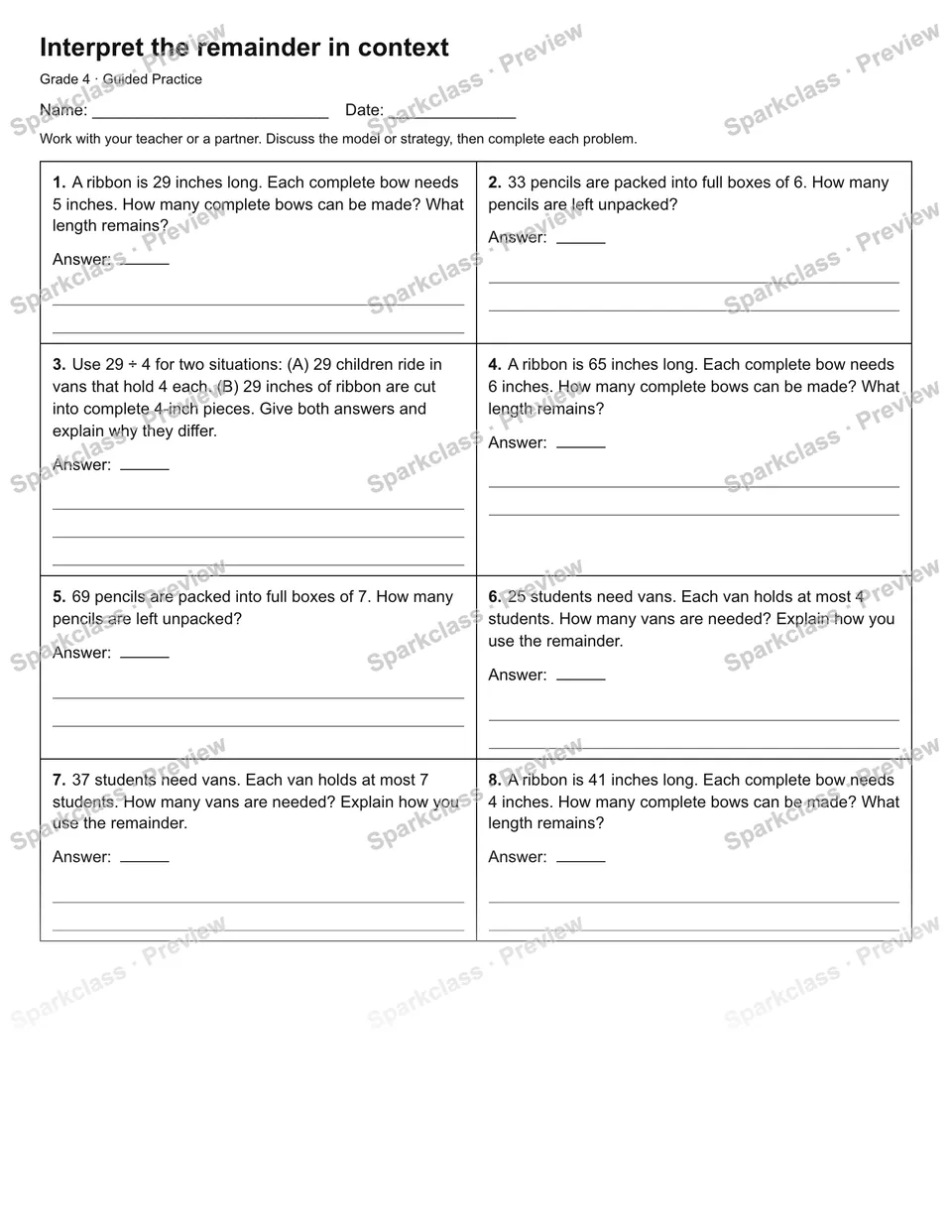
Grade 4 • Guided Practice • Work with your teacher or a partner. Discuss the model or strategy, then complete each problem.
Sample questions
- A ribbon is 29 inches long. Each complete bow needs 5 inches. How many complete bows can be made? What length remains?
Answer: ___
- 33 pencils are packed into full boxes of 6. How many pencils are left unpacked?
Answer: ___
- Use 29 ÷ 4 for two situations: (A) 29 children ride in vans that hold 4 each. (B) 29 inches of ribbon are cut into complete 4-inch pieces. Give both answers and explain why they differ.
Answer: ___
- A ribbon is 65 inches long. Each complete bow needs 6 inches. How many complete bows can be made? What length remains?
Answer: ___
- 69 pencils are packed into full boxes of 7. How many pencils are left unpacked?
Answer: ___
- 25 students need vans. Each van holds at most 4 students. How many vans are needed? Explain how you use the remainder.
Answer: ___
See the preview for diagrams, answer spaces, and the complete layout.
Common Core connections
Source labels: 4.OA.A.3, 4.NBT.B.6. Review the learning goals below to check the fit for your class.
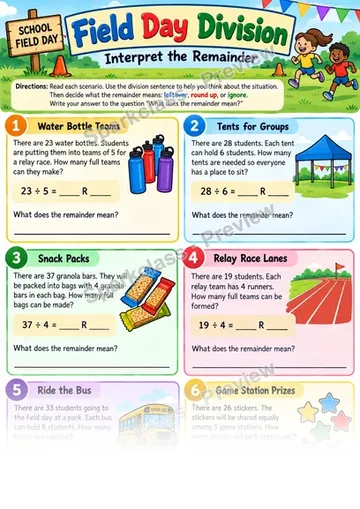
- 4.OA.A.3 — Multistep problems with remainders
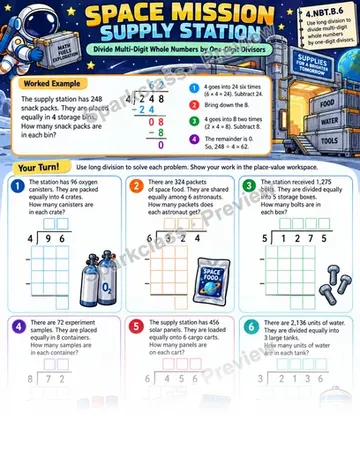
- 4.NBT.B.6 — Divide with up to four-digit dividends
Bring it into your lesson
Open this worksheet in Sparkclass to copy it to your Files. Check the resulting layout before sharing it with students.
Open in Sparkclass →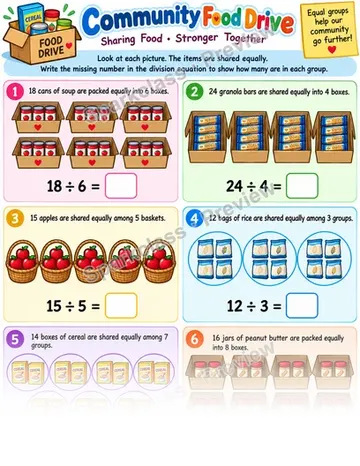 1 pages